Last updated: October 30, 2026
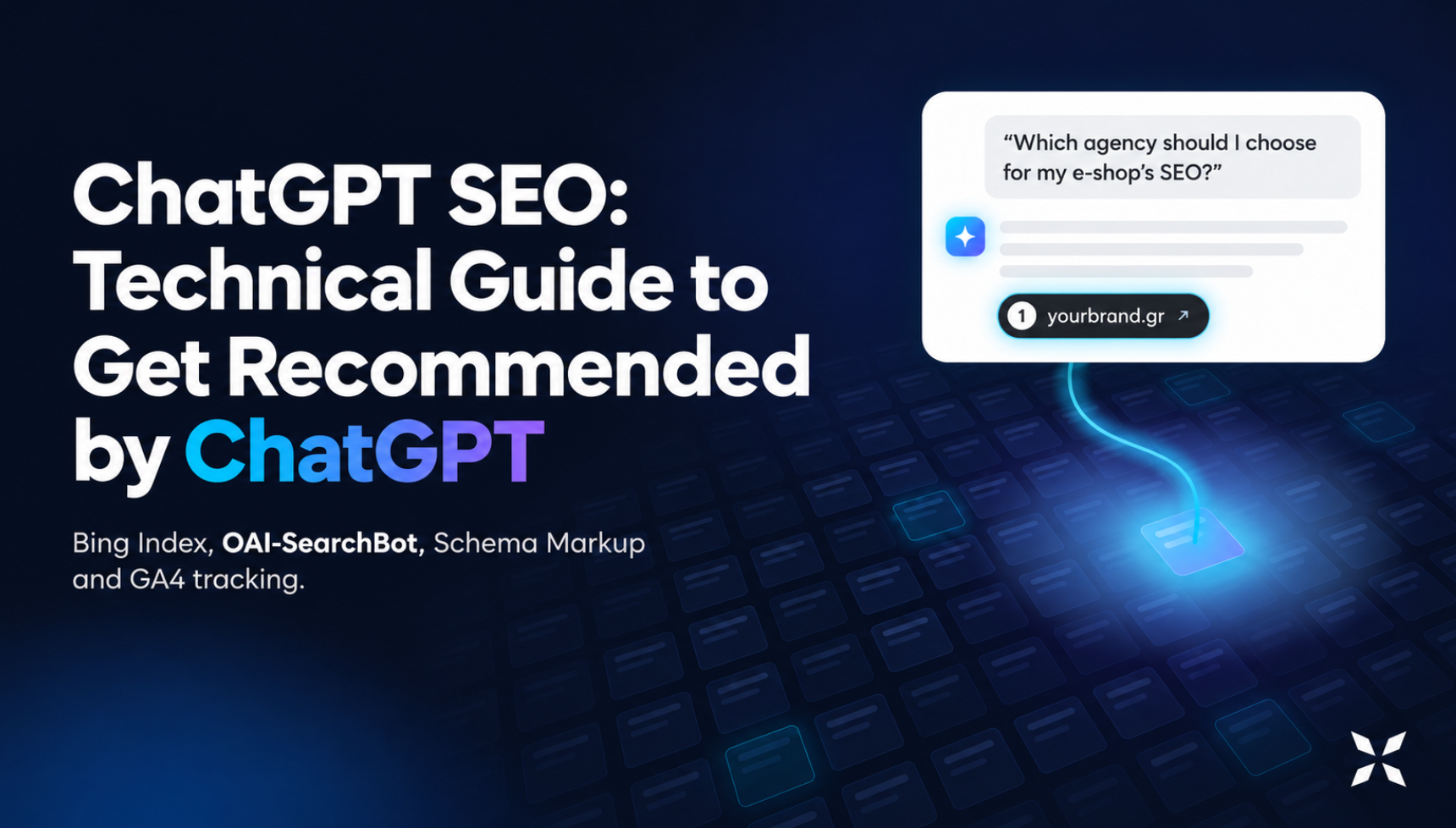
Getting your business into ChatGPT's answers requires a specialized ChatGPT SEO (GEO) strategy. OpenAI's architecture relies on hybrid search (Bing Index & OAI-SearchBot), and in practice, content that gives the answer up front (Answer-First structure) appears to be used more readily. Schema Markup for Entity Resolution and llms.txt (llmstxt.org) act as supporting practices.
From GEO theory to ChatGPT SEO in technical practice
In our introductory guide, From SEO to GEO, we covered the general theory of optimizing for AI engines, always working hand in hand with the foundations of classic SEO.
This guide, however, moves on to technical implementation. It is a hands-on implementation manual (actionable playbook), focused exclusively on the OpenAI (ChatGPT) ecosystem, setting out the steps required for the algorithm to find, process and recommend your business as a source it cites (citation).
ChatGPT's hybrid search system (Bing Index + OAI-SearchBot)
The scale of the market leaves no room for doubt: ChatGPT passed 900 million weekly active users in February 2026, an official OpenAI figure, and as early as July 2025 it was already processing more than 2.5 billion prompts a day (source: Axios). For any business with a digital presence, this translates into a critical channel for organic discovery.
To design an effective ChatGPT SEO strategy, you need to understand OpenAI's information retrieval architecture, which is built on a combination of sources (blended stack):
- Bing Search Index & Blended Index (Step 1): Since its launch, ChatGPT Search has relied on third-party search providers, the best known being Microsoft's index (Bing). Today, OpenAI combines the Bing index with its own crawling infrastructure, without disclosing how much weight each source carries. In practice, however, being in Bing remains the minimum requirement. If your website is missing from the Bing index, it is extremely difficult for ChatGPT to retrieve it in real time.
- Direct Web Crawling (Step 2): The dedicated OAI-SearchBot crawler visits your pages automatically, so they can appear in ChatGPT Search results. When a user asks a question, ChatGPT may also visit a page at the moment of the query via ChatGPT-User, to read the content and extract the exact answer.
In practice: verify your site in Bing Webmaster Tools, submit your XML sitemap and use URL Inspection to check that your key pages are indexed. Also enable IndexNow, so that Bing is notified immediately whenever you publish or update content. Microsoft itself points out that content freshness affects how quickly changes show up in AI-generated answers as well.
Architecture comparison table: ChatGPT vs other AI platforms
| GEO Parameter | OpenAI ChatGPT | Other AI platforms (Gemini, Perplexity, etc.) |
|---|---|---|
| Search Index Source | Hybrid (blended stack): Bing Search Index + OpenAI Web Index | Google Search Index (Gemini), its own index (Perplexity), etc. |
| Main AI Crawlers | OAI-SearchBot, GPTBot, ChatGPT-User, OAI-AdsBot | Googlebot (with the Google-Extended token), PerplexityBot, etc. |
| Tracking in GA4 | AI Assistant channel & chatgpt.com source | google.com (Organic/AI Overviews), perplexity.ai |
| Citation Format | Inline Footnotes & Native Search Cards | Carousels, Top Snippet Links, Numbered Cards |
| Core SEO Requirement | Bing Webmaster Tools, Schema Markup & OAI-SearchBot access | Schema.org, Knowledge Graph & presence in forums/communities |
OpenAI crawlers & robots.txt: The common developer trap
OpenAI uses four different crawlers. Understanding how they differ is critical to avoiding serious technical mistakes:
- OAI-SearchBot: The most critical crawler for ChatGPT Search. It indexes content so your site can appear in ChatGPT's search results.
- GPTBot: Collects data for training and improving OpenAI's future models.
- ChatGPT-User: Activated when a user asks ChatGPT or a Custom GPT a question and a page needs to be read in real time. It is not used for automatic crawling.
- OAI-AdsBot: Visits only the landing pages submitted as ads in ChatGPT Ads, to check that they comply with OpenAI's policies. Their content may also be used to determine when it is most relevant to show the ad.
Important technical clarification:
According to OpenAI's official documentation, only OAI-SearchBot determines whether your business appears in ChatGPT Search results. ChatGPT-User is triggered on demand by the user and does not affect general searches. In addition, because ChatGPT-User is a user-initiated action, OpenAI has clarified that it may not strictly follow robots.txt rules.
The developer trap:
Many developers block GPTBot to protect their content from being used for model training. That's acceptable. But if you block OAI-SearchBot, your business will not appear in ChatGPT's search answers, except possibly as a plain navigational link. That's why OAI-SearchBot is the one bot you should never block.
Correct robots.txt setup
A detail that matters: under RFC 9309, a bot that has its own group in robots.txt follows only that group and not User-agent: *. If you give a bot its own separate group with only Allow: /, that bot stops obeying the Disallow rules of User-agent: *, so if you already have rules such as Disallow: /cart or /admin, repeat them here as well:
User-agent: OAI-SearchBot
User-agent: GPTBot
User-agent: ChatGPT-User
Disallow: /cart
Disallow: /checkout
Disallow: /admin
Allow: /
If you want to appear in ChatGPT Search without allowing your content to be used for model training, give GPTBot its own group with Disallow: /:
User-agent: OAI-SearchBot
User-agent: ChatGPT-User
Disallow: /cart
Disallow: /checkout
Disallow: /admin
Allow: /

User-agent: GPTBot
Disallow: /
Including ChatGPT-User in the group has limited value: because its actions are initiated by users, it may not follow robots.txt rules. Also keep in mind that any robots.txt change takes about 24 hours to take effect in ChatGPT Search results.
Beyond robots.txt: firewalls, CDNs and JavaScript
Even with a correct robots.txt, your site can remain invisible to ChatGPT. Many CDNs and firewalls (WAFs), such as Cloudflare, have settings that block AI bots, often without the site owner knowing. That's why OpenAI recommends that, in addition to allowing OAI-SearchBot in robots.txt, you also allow requests from the IP ranges it publishes for each of its crawlers (e.g. searchbot.json). Check your firewall settings and server logs to make sure OpenAI's bots are not getting 403 errors.
In addition, according to Vercel's measurements (December 2024), OpenAI's crawlers did not execute JavaScript, so they could not see content that loads only client-side. Although there have been isolated, unconfirmed reports since late September 2026 that this is changing, the safe practice remains the same: your core content should already be in the initial HTML (server-side rendering or pre-rendering).
The llms.txt standard: A useful practice, not (yet) a confirmed requirement
Language models struggle to process heavy HTML code, JavaScript and complex menus. To address this, the llms.txt standard (llmstxt.org) has been proposed: a clean Markdown file in your website's root directory (e.g. domain.com/llms.txt).
What is officially confirmed
No major AI platform (OpenAI, Anthropic) has officially confirmed that it reads llms.txt when retrieving live answers in its chatbots (e.g. ChatGPT Search). OpenAI's official guidance focuses solely on OAI-SearchBot access. Google has gone a step further: its official guide to generative AI features already stated in May 2026 that llms.txt isn't needed, and in June 2026 Google explicitly clarified that it has no effect at all, positive or negative, on rankings in Google Search, including AI Overviews / AI Mode.
Why is it worth creating one?
Today, llms.txt serves as a practical tool for AI coding assistants (Cursor, Claude Code, GitHub Copilot) and MCP-based agents, which can use it to understand a site's structure faster. Anthropic itself publishes an llms.txt for its own documentation, precisely for this purpose. In fact, since May 2026 Google's Lighthouse 13.3 has included an explicit check for the presence and correct format of llms.txt in the new, still experimental "Agentic Browsing" category, although, as mentioned above, this does not imply any effect on Google Search rankings. Think of it as part of your technical infrastructure's basic hygiene and a low-cost investment in the future.
Adopting it early gives you a practical head start over competitors (first-mover advantage). According to recent adoption data, only 8–9% of the world's top websites have an llms.txt file (Rankability, September 2026). In short, its value lies in the wider AI agent ecosystem, not (for now) in traditional ranking-focused SEO.
Technical specifications (per llmstxt.org)
- An H1 title (# ...) with the name of your business or site: this is the only required section.
- A short summary in a blockquote (> ...) right after the title.
- Thematic H2 sections (## ...) with lists of Markdown links ([Page Title](https://domain.com/page)) to your most important pages.
- Clean text, without HTML tags or advertising noise.
Schema Markup (JSON-LD) as an "anchor" for entity resolution
Structured data (Schema Markup in JSON-LD format) helps with the process of Entity Resolution, that is, confirming that your business is a real, authentic entity.
OpenAI has not officially confirmed that ChatGPT reads Schema Markup. Microsoft, however, has stated that Schema helps Bing's LLMs understand content, and ChatGPT draws on the Bing Index. Google, for its part, makes clear in its guide that structured data isn't required for generative AI search features, but recommends keeping it as part of your overall SEO strategy. By using Schema Types such as Organization, Service and FAQPage, you make it easier to cross-check your details against the Bing Index, LinkedIn and official registries.
Recommended Schema Types for ChatGPT SEO
- Organization Schema: With complete sameAs details (links to social profiles, Wikidata, Crunchbase).
- Service / Product Schema: To clearly define the services or products you offer.
- FAQPage Schema: Clearly marks up the question-and-answer pairs on the page. The same Q&As should also appear as visible text, so that every system can read them, including those that don't use Schema. Note that Google stopped showing FAQ rich results on May 7, 2026.
Content structure for conversational intent & citation boosting
The way people search on ChatGPT is fundamentally different from classic search engines.
Complex natural-language queries (long-tail conversational prompts)
On Google, the user types: SEO agency Athens.
On ChatGPT, the same user writes a complex request:
“I'm looking for an agency in Athens with experience in custom e-commerce and ISO certification to take over my SEO. What are the best options?”
Content structure comparison
| Feature | Traditional Web Structure | Answer-First Structure (ChatGPT-ready) |
|---|---|---|
| Introduction | General definitions, introductory text | A 40–50 word Direct Answer at the start |
| Formatting | Long, unbroken paragraphs | Comparison tables & bullet lists |
| Evidence | Generic claims ("We are the best") | Precise data & measurable statistics |
| Focus | Keyword density | Direct answers to conversational intent |
Tactics for increasing citations
- Quotation & Expert Statements: Include verbatim statements from industry experts within the text.
- Technical Fluency & Entity Grounding: Use the precise technical terminology of your industry. LLMs trust texts that use specialized terms.
Off-page GEO: entity co-occurrence & brand mentions
ChatGPT SEO extends beyond the boundaries of your website. AI assesses a brand's overall digital reputation by analyzing third-party sources:
- Co-occurrence of entities: When your business name is frequently mentioned alongside concepts such as "ISO certification", "e-commerce SEO" or "top agency" on reputable portals, the LLM strongly associates your brand with these services.
- Digital PR & Wikidata: Coverage in news media, a presence on Wikidata and reviews on rating platforms strengthen your business's credibility and recognition as an entity in the eyes of the algorithm.
The importance of being recommended by AI is also backed by numbers. According to research by EMARKETER and Publicis Commerce among 1,179 US adults who had used an AI assistant or chatbot to research a product in the past month (January 2026), 49% say they are likely or very likely to try a different brand than usual if their AI assistant recommends an alternative. If ChatGPT doesn't mention your brand alongside searches in your industry, your competitors gain ground immediately.
Tracking & analytics: Measuring AI referrals in GA4
Measuring ChatGPT SEO performance starts with setting up your Google Analytics correctly, so you can track the traffic and the referral links that ChatGPT places in its answers.
Correct source filtering in Google Analytics 4
Since May 2026, GA4 automatically groups traffic from AI assistants (ChatGPT, Gemini, Copilot, etc.) into the new "AI Assistant" channel of the Default Channel Group, with no setup required: when the referrer is recognized as an AI assistant, GA4 sets the medium to "ai-assistant" and the campaign to "(ai-assistant)". For a more detailed view, or for data before May 2026, add a filter on the Session source dimension in the Traffic acquisition report (Reports → Acquisition → Traffic acquisition) that includes the following sources:
- chatgpt.com (web and apps, via links with utm_source=chatgpt.com)
- chat.openai.com (ChatGPT's older domain)
The simplest way is a filter on the Session source dimension with the match type "matches regex" and the value chatgpt\.com|chat\.openai\.com. For a permanent solution, create your own custom channel group under Admin → Data display → Channel groups.
Don't rely on the "referral" medium: links that carry only utm_source=chatgpt.com, without utm_medium, are recorded with the medium "(not set)" and usually end up in the Unassigned channel. In addition, visits from ChatGPT's mobile apps often arrive without a referrer: those carrying utm_source=chatgpt.com are recognized normally, while the rest are recorded as Direct and remain essentially "invisible" in GA4.
By monitoring the Engagement Rate and Key events (formerly Conversions) of these sources, you can assess the real commercial value of ChatGPT SEO.
The value of this tracking is also backed by the following data: when OpenAI started showing more prominent, clickable links in ChatGPT's answers (May 2026), referral traffic from ChatGPT rose by about 150% within a week (source: Similarweb data). For example, in a case study by Seer Interactive on one of its clients (October 2024–April 2025), traffic from ChatGPT showed a conversion rate of 15.9%, compared with just 1.76% for Google organic traffic on the same site. These figures, however, come from a single client; traffic from all AI tools combined was just 0.07% of organic traffic, and the data is now a year and a half old.
Frequently asked questions (FAQ)
Why is Bing Webmaster Tools essential for ChatGPT SEO?
Because ChatGPT Search uses the Bing index as a key source for the first stage of live search. If your website is not indexed by Bing, ChatGPT will struggle significantly to find your pages, even though OpenAI now combines the Bing index with its own crawling systems.
What is the difference between GPTBot and OAI-SearchBot?
GPTBot collects data to train future OpenAI models, while OAI-SearchBot indexes the web so that sites can appear in ChatGPT Search results. You can allow one and block the other in robots.txt, independently. If you block OAI-SearchBot, however, your site will not appear in ChatGPT's search answers.
What is Entity Resolution and how does Schema Markup help?
It is the process by which AI systems such as ChatGPT confirm that your business is a real, trustworthy entity. Schema Markup (JSON-LD), mainly of the Organization and Service types, provides structured data that helps the LLM cross-check your details against sources such as the Bing Index and LinkedIn. Microsoft has confirmed that Schema helps Bing's LLMs, while OpenAI has not taken an official position for ChatGPT.
How soon will you see results from ChatGPT SEO?
There is no fixed timeline, as it depends on the current state of your site. Changes to robots.txt take effect in ChatGPT Search in about 24 hours. If your website is already indexed by Bing and has correct Schema Markup, OAI-SearchBot can pick up your changes within a few days. For new or technically problematic sites, the entity resolution process may take several weeks to months.
Is llms.txt required for my business to appear in ChatGPT?
No. llms.txt is neither an official OpenAI requirement nor a ranking factor in Google, as Google itself made clear in its guide in May 2026 and explicitly clarified in June 2026. It does, however, remain a useful practice for the AI agents and development tools that use it, so it is worth creating as a low-cost investment in the future.
Alongside organic ChatGPT SEO, more and more businesses are combining their strategy with ChatGPT Ads, gaining immediate, paid visibility right below ChatGPT's answers.
Your business's presence in ChatGPT's answers doesn't happen by chance, nor is it secured by traditional SEO alone.
It requires a targeted technical architecture that connects your site directly to the indexes of OpenAI and Bing.
When your prospective customers search for solutions in your industry, does ChatGPT recommend your brand or your competitors?
Request a specialized ChatGPT SEO Audit here and claim your business's presence on the market's most popular AI assistant.